Let’s get the bias on the table first: we build LiMon, so this comparison is not neutral. What we can promise is that it’s honest. That includes being specific about the cases where you should buy OpenLM or Flexera instead of our product. Both are capable platforms run by serious companies, but they don’t have the same coverage, requirements or price.
The three tools get mentioned in the same conversations because they all answer some version of “what are our license servers doing?” But they’re built for different buyers with different problems, and most of the frustration we hear from businesses switching tools comes from having picked the right product for somebody else’s problem.
Side by side
| LiMon | OpenLM | Flexera FlexNet Manager | |
|---|---|---|---|
| Built for | License admins and IT teams running engineering license servers | Engineering license management at department-to-enterprise scale | Enterprise ITAM/SAM teams |
| Core job | Monitor servers, keep history, prove usage at renewal/audit time | Monitor + actively manage (harvesting, allocation) | Full asset lifecycle: discovery, entitlements, compliance |
| License managers covered | FlexLM, RLM, LM-X, DSLS | Broad: 100+ license managers and cloud platforms | Broad, via engineering-applications module |
| Deployment | On-prem only: Docker, DEB, RPM | Cloud-first; on-prem available | On-prem or Flexera One (cloud) |
| Agents | None | Optional for monitoring; required for idle detection/harvesting | Endpoint agents for discovery |
| Cloud dependency | None; air-gap friendly, no phone-home | None for on-prem deployments; cloud edition requires a Broker, which sends your usage data to OpenLM | Depends on edition |
| Implementation | ~15 minutes, self-service | Days to weeks depending on components | Weeks to months, usually with professional services |
| Pricing | Public, one-time. No sales calls. Ever. | Public per-user subscription; contact sales above 100 users | Contact sales; enterprise budgets |
| Endpoint/install discovery | No | Limited (license-focused) | Yes, a core feature |
| Entitlement reconciliation | No | Partial | Yes, a core feature |
| License harvesting | No | Yes | Within engineering module |
| Evaluation | 60 days, self-service, no credit card | 30-day free trial | Via sales |
Capabilities of other vendors summarized from public materials in August 2026. Verify details against OpenLM's documentation and Flexera's engineering-applications documentation; both are actively developed products.
The table leaves out some of LiMon’s supporting workflows: scheduled and live intelligence reports, notifications by email, Slack, and Teams, announcements to license users, sign-in with roles (local or AD/LDAP), CSV/XLS exports, estate-wide license search, username masking and anonymization, log import, and a friendly web-based administration interface, among others. The features page expands on them if you are interested.
And it cannot show you how much effort we put into automatically transforming the raw data into clear and actionable insights. The basic usage analysis for an application, for one, opens by saying what the numbers mean:
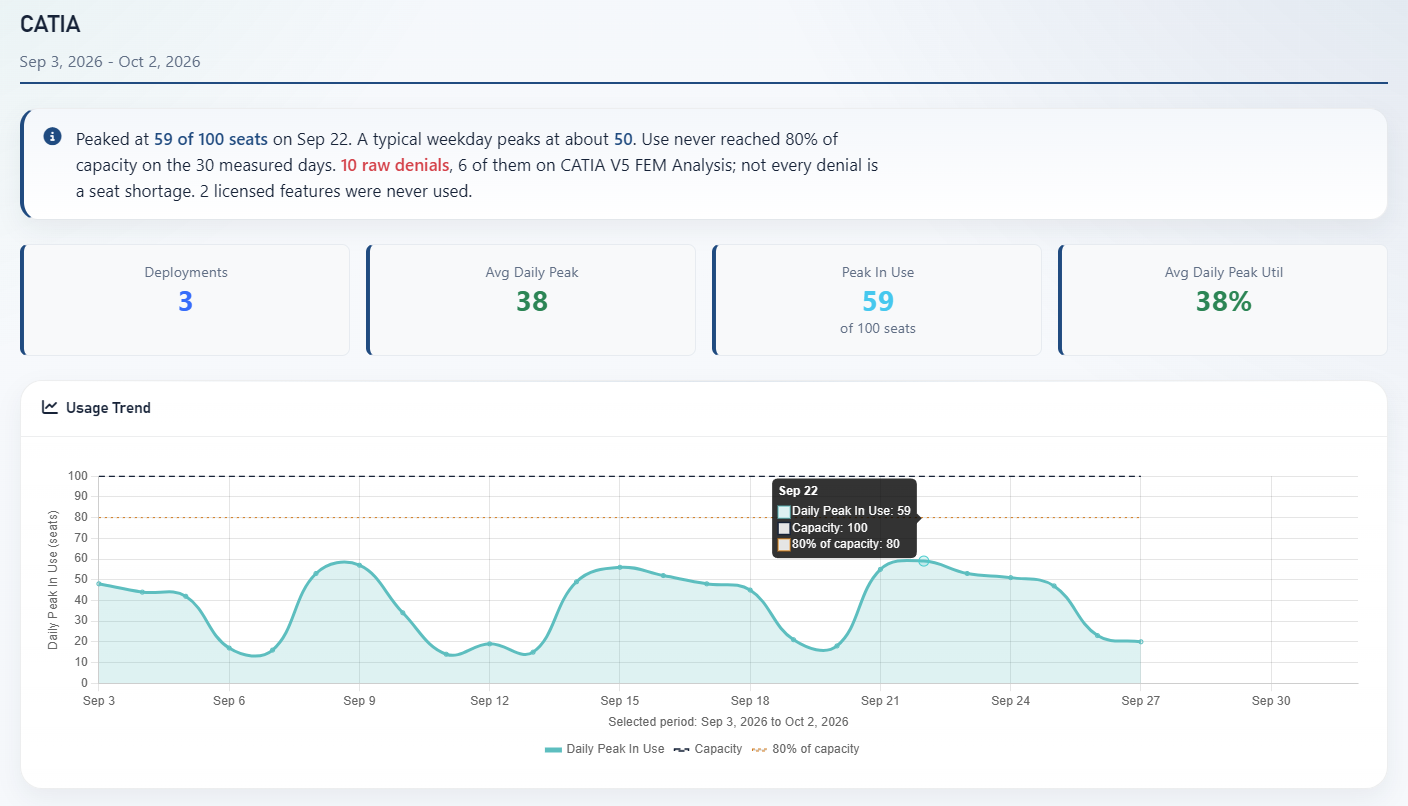
The three tools at a glance
Flexera FlexNet Manager is an enterprise software-asset-management (ITAM/SAM) platform. It discovers software across your endpoints, reconciles installations against purchase entitlements, manages compliance positions across hundreds of vendors, and also tracks concurrent license usage through its engineering-applications module.
A detail worth knowing: Flexera also makes FlexNet Publisher, i.e. FlexLM itself. They sit on both sides of the table, selling licensing technology to software vendors and license management to those vendors’ customers. It’s sold to enterprise ITAM teams, quoted rather than priced, and typically deployed with a professional-services engagement.
OpenLM is a dedicated engineering-license-management platform and the most direct functional competitor to LiMon. It covers more than 100 license managers and cloud licensing platforms, including FlexLM, RLM, LM-X and DSLS, and goes beyond monitoring into active management: with its workstation agent it can identify idle sessions and reclaim (“harvest”) licenses left open overnight.
It is now a cloud-first product, with an on-prem option still available. Pricing is a per-user subscription; above 100 users, it’s a sales call and a quote. A typical deployment involves several components, including the platform, broker, workstation agents, and directory synchronization, depending on which capabilities you need.
LiMon is an on-prem monitoring appliance for FlexLM, RLM, LM-X, and DSLS. It polls your license servers over the network using the vendors’ own utilities, stores the history, maps features to applications and users to departments, imports server logs for denial analysis, and produces dashboards and executive-ready Intelligence Reports (estate, application, site, savings, audit defense, chargeback) as live web views and PDF/CSV exports — sample reports are published as PDFs.
It installs from a Docker bundle, DEB, or RPM in about fifteen minutes, puts no agents anywhere, never phones home, and is priced on the public pricing page: one-time, perpetual, with optional annual maintenance. It deliberately does not do endpoint discovery, entitlement reconciliation, or license harvesting.
Where Flexera genuinely wins
If your organization needs to know everything installed on every endpoint, reconciled against every contract you’ve signed, across desktop software, datacenter, SaaS, and cloud, that’s literally what FlexNet Manager is for, and neither LiMon nor OpenLM replaces it.
The telltale signs you’re a potential Flexera buyer: you have a dedicated ITAM team, vendor audits land at the CIO level rather than the license admin’s inbox, you need compliance positions for vendors like Microsoft, Oracle, SAP, and IBM, and “six to seven figures plus implementation” is a budget conversation your organization can actually have.
The mismatch happens when a 500-person engineering firm that just wants to know whether its Ansys pool is oversized walks into an enterprise SAM sales cycle. You don’t need an asset-management platform to answer a license-server question.
Where OpenLM genuinely wins
OpenLM’s two structural advantages over LiMon are:
- Coverage breadth. If your estate includes license managers beyond FlexLM, RLM, LM-X, and DSLS, such as Beta LM, MathLM-specific edge cases, or one of the many niche managers OpenLM supports, LiMon simply doesn’t cover them today, and OpenLM very likely does.
- Active management. LiMon shows you long checkouts and pools that are bigger than they need to be; OpenLM can see whether the user is actually working and take the license back. If reclaiming idle sessions automatically is a hard requirement (in very large CAD estates, harvesting alone may help justify the tool’s price), that’s OpenLM’s home turf, and it requires exactly the kind of workstation agents LiMon refuses to deploy.
There’s a trade hiding in that second point, though. Harvesting requires agents on workstations, which means a software rollout and everything that follows one: a new attack surface for the security team to assess, plus a fleet of agents to patch, upgrade, and keep compatible with every OS and application refresh from then on.
Plenty of teams discover that what they actually needed was the evidence of idleness to fix the problem organizationally, through fewer seats at renewal or schedule changes, rather than software that kills sessions. If you’re unsure which you need, that’s a strong hint to start with monitoring and add management only if the data demands it.
Where LiMon wins
LiMon is built around three opinions, and if you share them, the choice gets easy:
The data should stay yours, on your network. No cloud tenancy, no phone-home, no agents on license servers or workstations. The Docker bundle ships its images inside the tarball; native packages carry offline Python wheels. Defense contractors and any security-conscious engineering or development shop can run it fully air-gapped. If your security review or your finances treat “SaaS” as an issue, this is the difference that ends the evaluation.
A license admin should be able to deploy it alone, in an afternoon, without a budget meeting. Install is a docker-install.sh or an apt/dnf install plus a setup wizard. Pricing is on the website: one-time, perpetual, with maintenance optional after the first year. You can match it against a departmental budget without a quote cycle or a sales call. The 60-day evaluation is self-service with Professional features enabled.
Monitoring should produce arguments, not just charts. The output LiMon optimizes for is the renewal meeting and the audit response: peak-vs-owned analysis, denial evidence from imported logs, savings and audit-defense PDFs that finance and auditors can read, and an automatic inventory change history so “when did this change?” has a documented answer. It is designed to be friendly to end users and admins without any training or course.
When not to pick LiMon
Saving you an evaluation cycle is cheaper for both of us than a refund conversation, so plainly:
- You need license managers beyond FlexLM, RLM, LM-X, and DSLS. We’d rather you knew that in the first five minutes; our coverage will widen but it is deliberately deep rather than wide.
- You need automatic license harvesting. LiMon won’t kill idle sessions — by design, since we prefer to leave that in human hands rather than in our software.
- You need endpoint discovery or entitlement reconciliation across your whole software estate. That’s an ITAM suite’s job.
- You want a managed SaaS where someone else runs the infrastructure. LiMon is an appliance you host; that’s the point of it.
The decision in three questions
Start with the first question and follow the continue branch until the answer points to a tool.
How broad is the problem?
Do you need to monitor and prove, or also actively reclaim?
Does this describe the deployment you want?
On-prem, no agents, published pricing, and running before lunch.
A footnote on a fourth name that shows up in these searches: X-Formation’s License Statistics is another dedicated monitoring tool, closer to LiMon’s shape than to the suites. If you’re comparing against it, the questions above work the same way: deployment model, agents, pricing transparency, and whether the reports speak finance.
Whichever way you go: the teams that regret their choice are the ones that bought a platform when they had a monitoring problem, or a monitor when they had a platform problem. Match the tool to the problem, and each one can be the right choice.